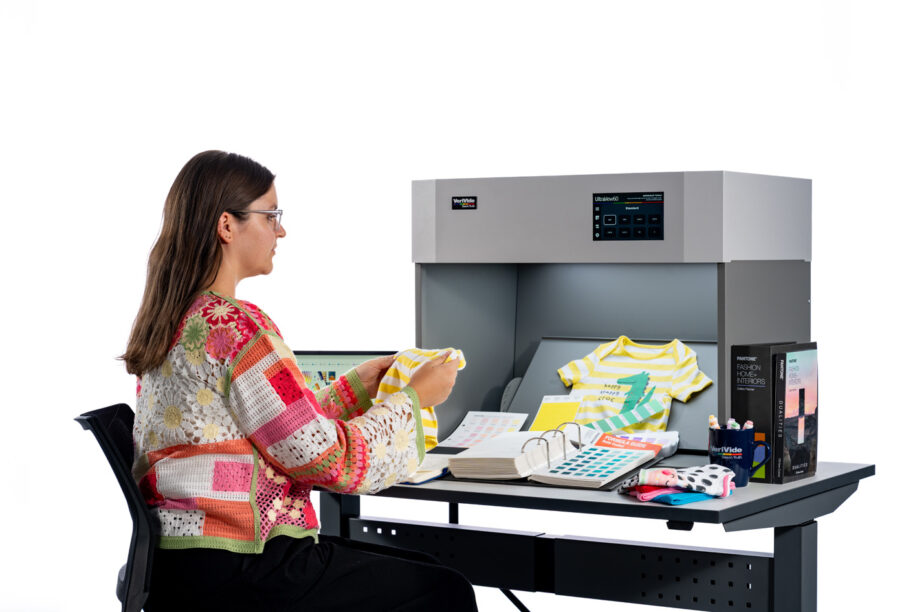
The new UltraView60 by VeriVide delivers the same colour assessment technology and performance as the existing UltraView system, but in a more compact and cost-effective format suited to businesses with limited space or smaller testing requirements.
At the same time, UltraView has been renamed UltraView90, creating a two-model range with different viewing areas while maintaining the same core capabilities. The launch comes as brands, manufacturers, suppliers and testing laboratories increasingly shift from fluorescent lighting to LED technology for visual colour assessment.
Fundamental consistency
Consistent lighting conditions are fundamental to colour evaluation throughout textile supply chains, particularly where materials and finished products may be assessed at several different locations before reaching the consumer. Changes in lighting technology therefore need to be introduced consistently if manufacturers and their customers are to avoid discrepancies in colour approval.
VeriVide, based in Leicester, UK, has specialised in controlled lighting and colour assessment for more than 60 years and developed the UltraView range to provide greater flexibility as specifications continue to evolve.
Both UltraView60 and UltraView90 employ tuneable LED technology and are supplied with 14 pre-programmed illuminants, including VeriVide’s A-rated CIE D65 and CIE D50, CIE Illuminant A and a range of LED and other specified light sources. The systems are designed to meet or exceed international colour assessment standards including ISO 3664, ISO 3668, ISO 13076, ISO 23603, ASTM D1729, AATCC EP9 and BS 950-1.
Greater flexibility across multiple sites
The introduction of UltraView60 also gives organisations greater flexibility in deploying common technology across different facilities. Larger viewing areas can be provided by UltraView90 where required, while the smaller UltraView60 can be installed at locations where space, cost or the scale of testing makes the larger cabinet unnecessary.
Both systems use a digital touchscreen rather than the numbered buttons traditionally employed on colour assessment cabinets. Individual illuminants are clearly identified on screen, allowing operators to switch quickly between different lighting conditions when checking colour appearance and metamerism.