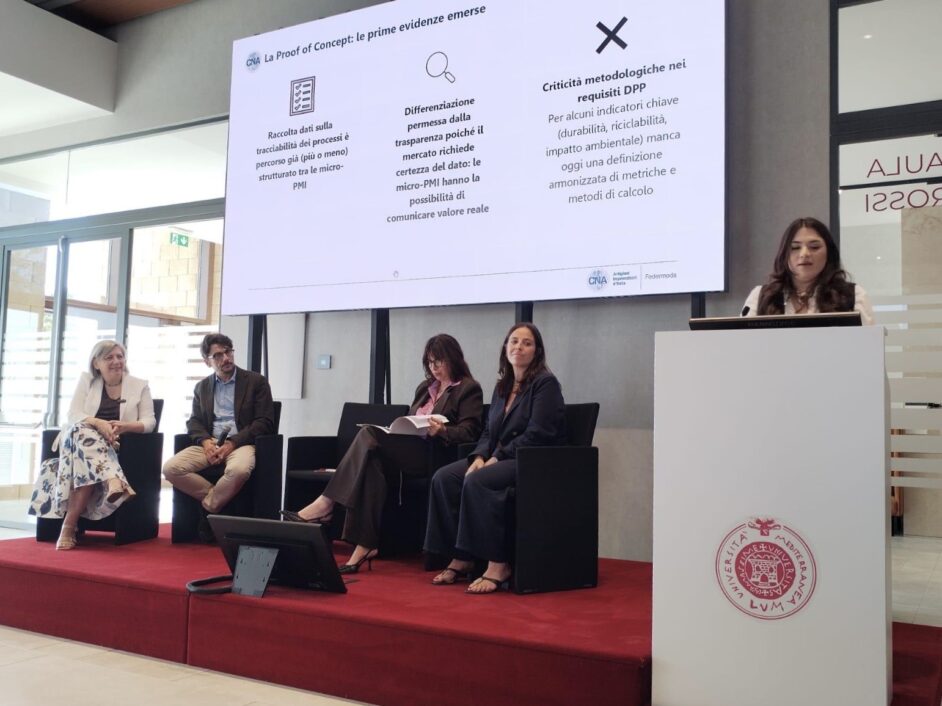
At the ICESP workshop on the European Ecodesign Regulation and the Digital Product Passport (DPP), CNA Federmoda reiterated the topic of the fashion industry’s transition to more transparent and sustainable models. The message is clear: there’s no need to wait until the regulatory framework is definitively defined. For micro and small businesses, delaying compliance risks losing ground in a market that already rewards transparency, responsibility, and the ability to demonstrate the value of their products and processes.
For this reason, CNA Federmoda has chosen to move from the observation phase to the operational phase, activating a Proof of Concept involving five pilot companies selected from within the association: Rossorame (AMETLAB), Selbi Studio, Le Panier Bags, L’Impermeabile and Wladi Rigato. These five micro and small businesses, both proprietary and subcontractors, represent different product categories in the fashion supply chain (from clothing to accessories, from leather goods to outerwear to footwear). They were chosen to concretely test the applicability of the new European regulatory framework and the Digital Product Passport in different production contexts.
Adapting to different business realities
This choice reflects the real complexity of the Italian fashion system and the need to build tools capable of adapting to profoundly different corporate structures, processes, and business models.
“Businesses shouldn’t wait for regulations to force them to change. They need to be supported now, with tools commensurate with their structure, organization, and operational capabilities,” says Caterina Mazzei, CNA Federmoda’s sustainability and circular economy coordinator.
The initial findings from the process are significant: in micro and small businesses, data already exists. It exists in the processes, in the selection of materials, in the knowledge of the supply chain, in the production skills developed over time: the value is already there. The key is to make it legible, structured, and communicable.
Valorising data assets
This is the context for the collaboration with BCODE, the technology partner chosen to build an infrastructure capable of translating the complexity of small businesses into concrete, interoperable, and sustainable tools that can organize and leverage the information assets already present within companies.
For CNA Federmoda the Ecodesign Regulation represents a strategic transformation that can redefine the competitive positioning of Italian companies. For this transition to be truly effective, however, clear rules, harmonized metrics and accessible tools are needed, built with a principle of proportionality that takes into account the reality of micro and small businesses.